
Putting ketchup on a hot dog?! That a no-no here in Chicago. We’ll talk about that, and other unique, often quirky unwritten rules for living in Chicago.
PHPUgly - 182:Remote Working 🏡
This week Thomas and Eric discuss how the entire world has decided to catch up with the technology of the times and start working remotely. Well that and a small pandemic to also help motivate companies. So what next? How are companies adjusting to remote life? The government is encouraging people to stay at home, work from home, and don't have any physical contact with other people, in short, a great time to be a developer.
We do hope everyone is staying safe and enjoy this episode of PHPUgly.
Show Notes:
Curious City - Chicago’s Got 1 Thai Restaurant For About Every 33 Thai People: How Come?
Fourteen-year-old Evan Robinson is a Chicago foodie — you might have even seen him on Master Chef Junior. Over the years, when he’s gone to see his orthodontist on 55th Street in Hyde Park, he’s noticed a tasty mystery.
“We always see all these different Thai restaurants,” he says, referring to Snail Thai Cuisine, Siam Thai Cuisine and Thai 55 Restaurant.. “I think that’s crazy that there are three [within] one block right here.”
Evan’s dad, Christopher, has lived in a lot of Chicago neighborhoods and says he’s noticed similar situations there, too.
“There seemed to be a Thai restaurant in almost every neighborhood,” Christopher says.
So Evan and Christopher wrote in to Curious City asking:
Why are there so many Thai restaurants in Chicago?
While there may not be a Thai restaurant in every Chicago neighborhood, there are a lot. According to Thai officials, the greater metropolitan area has about 300 Thai restaurants, but only about 10,000 Thai residents. This breaks down to about one restaurant for every 33 Thai people — twice the national average.
In the 1970s, thousands of Thai doctors, nurses and students started immigrating to the U.S., and Illinois was the third most popular destination (behind Los Angeles and New York City). A few of these immigrants started opening restaurants in the early ‘70s, and by the 80’s and ‘90s Chicago was in the middle of a Thai restaurant boom.
“It seemed like every few months a Thai restaurant popped up,” says nurse-turned-chef Chanpen Ratana, who at one point owned four Thai restaurants in Chicago.
Experts believe this big early wave of Thai immigration laid the familiarity with — and demand for — the solid Thai restaurant scene we have today.
As to why so many of these Thai immigrants decided to go into the restaurant business: Thai chefs, business scholars and government officials say it has to do with a culture of cooking and entrepreneurship. Plus, a Thai government “gastrodiplomacy” program aimed at promoting Thai cuisine across the world has given many local restaurants an extra boost.

Thais know food
Chef Arun Sampathavivat of Arun’s Thai Restaurant says a big reason for the large number of Thai restaurants in Chicago — and across the world — is that Thais are natural cooks.
“Thai people usually love to cook. They can cook anything,” Sampathavivat says. “Unlike most people who are not comfortable in the kitchen, most Thais can cook spontaneously right away. It's in them.”
While it might sound like hyperbole, several people interviewed for this story gave a similar explanation, and Sampathavivat’s own story suggests there’s some truth to it. He came to Chicago as a University of Chicago graduate student with no cooking training, then became one of the most celebrated Thai chefs in the world.
Sampathavivat also notes that many Thais are exposed to quality food culture at an early age as a part of their religious practice.
“When Thais go to temple, we bring food to offer to the Buddha, and we have to bring the best we can,” he says. “There is almost an implicit contest. Like, ‘The better I do, the higher level of heaven I can go to.’ The result is that you learn about great food at the temple even outside of your own family.”

Thai culture promotes entrepreneurship
In a 2016-2017 survey, Thailand ranked second among 65 countries in number of business owners, which carries a high social status in the country.
“Thailand is very positive toward entrepreneurs and entrepreneurship” says Ulrike Guelich of the Global Entrepreneurship Monitor in Bangkok. “We have 20% of the population who are starting a business and 20% who run established businesses.”
For Sampathavivat, Thai entrepreneurship comes out of his countrymen’s love of freedom.
“Thai people don’t like to be hired by anyone,” he says. “They are not [very] good employees, but they can be a good boss, because they like to have their own thing. They like to be independent.”
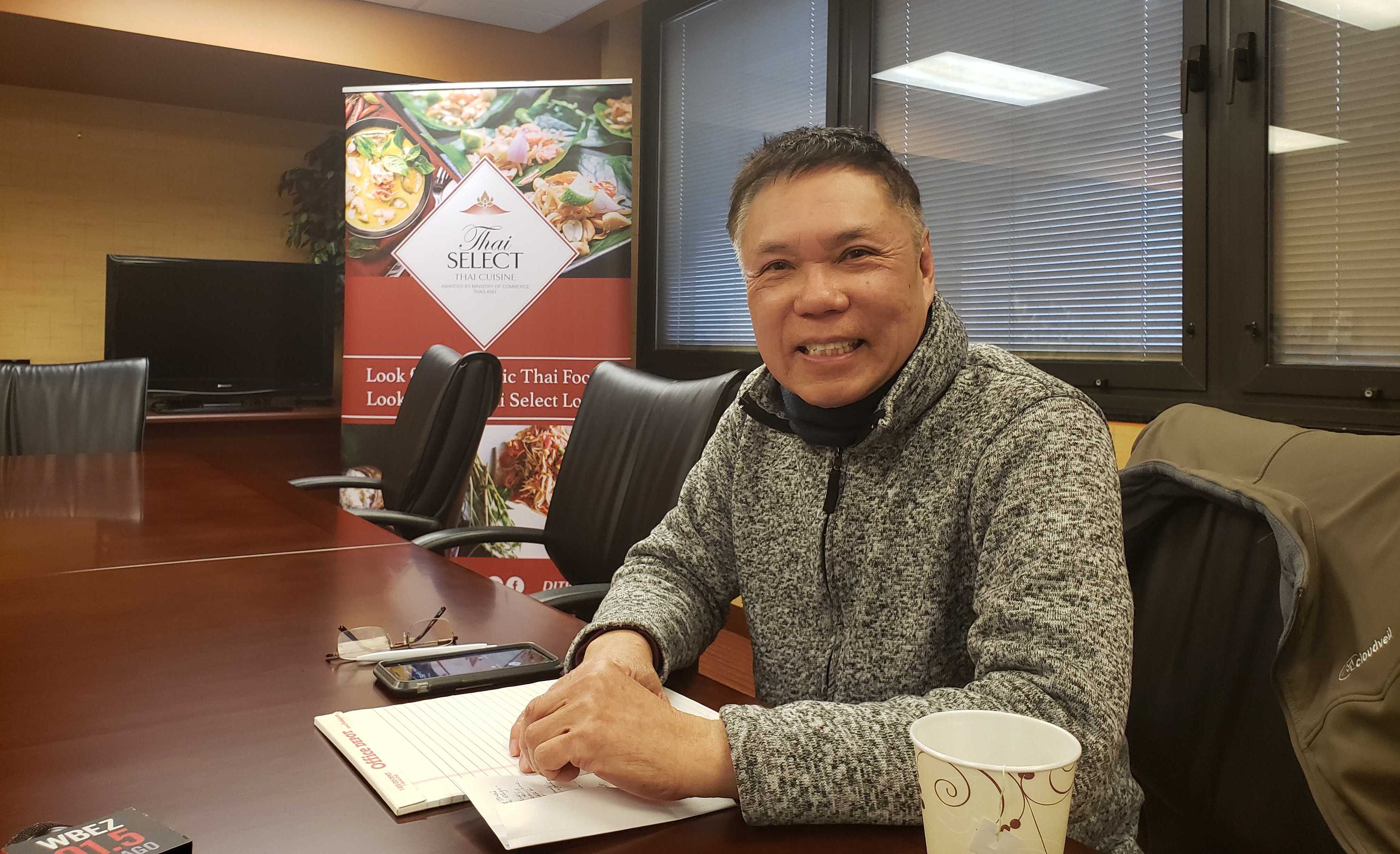
Despite this independent streak, Sampathavivat says, many Thais are happy to replicate the models of existing businesses and even open them in the same area.
“Thai people like to follow the kind of fashion or trend,” Sampathavivat says. “When one is doing this, the other one likes to do it, too. And before you know it [the same businesses are] all over the market just as fast as they can start.”
This may help explain some of Chicago’s Thai restaurant clusters — past and present — in Hyde Park, Lakeview, Lincoln Square, Albany Park and downtown.
The Thai government gives restaurants support
And if a culture of cooking and entrepreneurship isn’t enough?
In 2000, the Thai government launched a gastrodiplomacy program aimed at expanding tourism to Thailand by promoting authentic Thai restaurants around the world. The program funded food research and provided money to help restaurateurs design, launch, market and maintain standards in their restaurants.
Some have credited the program with the heavy presence of Thai restaurants in the U.S., but data show many were well-established long before the program started.
“We go to events like Chicago Gourmet and promote Thai food. We don’t subsidize the restaurants but just do the marketing campaigns for them,” says Chicago Thai Trade representative Usasri Kheorayab.

Part of that marketing campaign includes something called the “Thai Select” program. It highlights restaurants that maintain specific quality standards and levels of Thai authenticity. Thai commerce officials award qualifying restaurants with the “Thai Select” seals that you can find in the windows of dozens of Chicago-area Thai restaurants.
More about the question asker

Evan Robinson was born and raised in Chicago, where he’s now a freshman at William Jones College Preparatory High School. He became a finalist on MasterChef Junior when he was just 10 years old.
“That was an amazing experience, because I got to meet a lot of other kids who like cooking like I do,” he says.
After MasterChef Junior, “I got a lot of opportunities to do things like work with Whole Foods and the Mushroom Council, where I had a series of videos where we substituted meat with mushrooms for healthier dishes that tasted as amazing, if not better, than they did before.”
When he’s not at school or cooking, “I like to play video games and hang out with my friends.”
His favorite dish at Snail Thai in Hyde Park is an egg noodle dish called birds nest noodles.
But he’s alway up for trying new restaurants with his family. A big fan of eel rolls and spicy salmon rolls, Evan says he’s been eyeing “a new sushi place that opened up in Hyde Park that looks pretty cool.”
Monica Eng is a reporter for Curious City. You can follow her @MonicaEng.
Curious City - Chicago’s Got 1 Thai Restaurant For About Every 33 Thai People: How Come?
Fourteen-year-old Evan Robinson is a Chicago foodie — you might have even seen him on Master Chef Junior. Over the years, when he’s gone to see his orthodontist on 55th Street in Hyde Park, he’s noticed a tasty mystery.
“We always see all these different Thai restaurants,” he says, referring to Snail Thai Cuisine, Siam Thai Cuisine and Thai 55 Restaurant.. “I think that’s crazy that there are three [within] one block right here.”
Evan’s dad, Christopher, has lived in a lot of Chicago neighborhoods and says he’s noticed similar situations there, too.
“There seemed to be a Thai restaurant in almost every neighborhood,” Christopher says.
So Evan and Christopher wrote in to Curious City asking:
Why are there so many Thai restaurants in Chicago?
While there may not be a Thai restaurant in every Chicago neighborhood, there are a lot. According to Thai officials, the greater metropolitan area has about 300 Thai restaurants, but only about 10,000 Thai residents. This breaks down to about one restaurant for every 33 Thai people — twice the national average.
In the 1970s, thousands of Thai doctors, nurses and students started immigrating to the U.S., and Illinois was the third most popular destination (behind Los Angeles and New York City). A few of these immigrants started opening restaurants in the early ‘70s, and by the 80’s and ‘90s Chicago was in the middle of a Thai restaurant boom.
“It seemed like every few months a Thai restaurant popped up,” says nurse-turned-chef Chanpen Ratana, who at one point owned four Thai restaurants in Chicago.
Experts believe this big early wave of Thai immigration laid the familiarity with — and demand for — the solid Thai restaurant scene we have today.
As to why so many of these Thai immigrants decided to go into the restaurant business: Thai chefs, business scholars and government officials say it has to do with a culture of cooking and entrepreneurship. Plus, a Thai government “gastrodiplomacy” program aimed at promoting Thai cuisine across the world has given many local restaurants an extra boost.
Thais know food
Chef Arun Sampathavivat of Arun’s Thai Restaurant says a big reason for the large number of Thai restaurants in Chicago — and across the world — is that Thais are natural cooks.
“Thai people usually love to cook. They can cook anything,” Sampathavivat says. “Unlike most people who are not comfortable in the kitchen, most Thais can cook spontaneously right away. It's in them.”
While it might sound like hyperbole, several people interviewed for this story gave a similar explanation, and Sampathavivat’s own story suggests there’s some truth to it. He came to Chicago as a University of Chicago graduate student with no cooking training, then became one of the most celebrated Thai chefs in the world.
Sampathavivat also notes that many Thais are exposed to quality food culture at an early age as a part of their religious practice.
“When Thais go to temple, we bring food to offer to the Buddha, and we have to bring the best we can,” he says. “There is almost an implicit contest. Like, ‘The better I do, the higher level of heaven I can go to.’ The result is that you learn about great food at the temple even outside of your own family.”
Thai culture promotes entrepreneurship
In a 2016-2017 survey, Thailand ranked second among 65 countries in number of business owners, which carries a high social status in the country.
“Thailand is very positive toward entrepreneurs and entrepreneurship” says Ulrike Guelich of the Global Entrepreneurship Monitor in Bangkok. “We have 20% of the population who are starting a business and 20% who run established businesses.”
For Sampathavivat, Thai entrepreneurship comes out of his countrymen’s love of freedom.
“Thai people don’t like to be hired by anyone,” he says. “They are not [very] good employees, but they can be a good boss, because they like to have their own thing. They like to be independent.”
Despite this independent streak, Sampathavivat says, many Thais are happy to replicate the models of existing businesses and even open them in the same area.
“Thai people like to follow the kind of fashion or trend,” Sampathavivat says. “When one is doing this, the other one likes to do it, too. And before you know it [the same businesses are] all over the market just as fast as they can start.”
This may help explain some of Chicago’s Thai restaurant clusters — past and present — in Hyde Park, Lakeview, Lincoln Square, Albany Park and downtown.
The Thai government gives restaurants support
And if a culture of cooking and entrepreneurship isn’t enough?
In 2000, the Thai government launched a gastrodiplomacy program aimed at expanding tourism to Thailand by promoting authentic Thai restaurants around the world. The program funded food research and provided money to help restaurateurs design, launch, market and maintain standards in their restaurants.
Some have credited the program with the heavy presence of Thai restaurants in the U.S., but data show many were well-established long before the program started.
“We go to events like Chicago Gourmet and promote Thai food. We don’t subsidize the restaurants but just do the marketing campaigns for them,” says Chicago Thai Trade representative Usasri Kheorayab.
Part of that marketing campaign includes something called the “Thai Select” program. It highlights restaurants that maintain specific quality standards and levels of Thai authenticity. Thai commerce officials award qualifying restaurants with the “Thai Select” seals that you can find in the windows of dozens of Chicago-area Thai restaurants.
More about the question asker
Evan Robinson was born and raised in Chicago, where he’s now a freshman at William Jones College Preparatory High School. He became a finalist on MasterChef Junior when he was just 10 years old.
“That was an amazing experience, because I got to meet a lot of other kids who like cooking like I do,” he says.
After MasterChef Junior, “I got a lot of opportunities to do things like work with Whole Foods and the Mushroom Council, where I had a series of videos where we substituted meat with mushrooms for healthier dishes that tasted as amazing, if not better, than they did before.”
When he’s not at school or cooking, “I like to play video games and hang out with my friends.”
His favorite dish at Snail Thai in Hyde Park is an egg noodle dish called birds nest noodles.
But he’s alway up for trying new restaurants with his family. A big fan of eel rolls and spicy salmon rolls, Evan says he’s been eyeing “a new sushi place that opened up in Hyde Park that looks pretty cool.”
Monica Eng is a reporter for Curious City. You can follow her @MonicaEng.
More or Less: Behind the Stats - The mystery of Iran?s coronavirus numbers
Does Iran have a lot more covid-19 cases that its figures suggest?
The Skeptics' Guide to the Universe - The Skeptics Guide #766 – Mar 14 2020
What's the Word: Moiety; News Items: Shorter Day in Past, Handwashing, CAM for Coronavirus, Lift Follow Up; Who's That Noisy; Science or Fiction
CoinDesk Podcast Network - LEIGH: Udi Wetheimer on Real Bitcoin Use and Cyperpunk Myths
The cypherpunk movement has expanded far beyond the 2,000 people who subscribed to mailing lists in the 1990s. In 2018, Entrepreneur reported there are more than 8,000 posts on Bitcointalk every day, while Coinbase garnered millions of user accounts. Such experimental technology is no longer the realm of just a few thousand geeks.
However, across the board, even in 2020 cypherpunk projects rarely exceed a few dozen regular contributors. For example, Exiledsurfer, an event organizer and hacker space co-founder from the Parallele Polis collective, said his space in Vienna was inspired by a collective in Prague that collects roughly $5,000 a month in cryptocurrency from members to share a venue. Likewise, the Vienna chapter accepts dues in DAI, monero and bitcoin, just to name a few.
“We’re a crypto pure organization,” Exiledsurfer said. “This will be an alternative asset class or, in a hundred years, there will by three guys in a garage in Topeka, Kansas, tweaking on a 2020 computer to keep the chain alive, just like people tweak on old cars.”
The cypherpunk movement appears to be growing, albeit slowly.
“I still get people every week, young people and programmers who say they want to give their lives to this thing,” cypherpunk icon Amir Taaki said, underscoring why he believes the movement will only succeed through groups with “structured” training methods.
“There’s a yearning need for this...we can build our own financial networks outside of the control of the state,” Taaki said of the academy he plans to launch in Barcelona.
“How do all of these pieces that we’re working on fit together to serve a higher goal? What’s our narrative?” Taaki said.
Yet, even as a cypherpunk technology aficionado, Wertheimer disagrees with such collectivist views of “our” narrative or “pure” projects.
“I don’t think we need bitcoin evangelists,” Wertheimer said. We’ll talk about why he views the ideological movement as divorced from user groups that may now utilize cypherpunk technology.
Want more? Read my article about how bitcoin compares to the early days of the internet.
See Privacy Policy at https://art19.com/privacy and California Privacy Notice at https://art19.com/privacy#do-not-sell-my-info.
Talk Python To Me - #255: Talking to cars with Python
See the full show notes for this episode on the website at talkpython.fm/255
Amicus With Dahlia Lithwick | Law, justice, and the courts - The Law of Public Health
Dahlia Lithwick is joined by Professor Michele Goodwin, Chancellor’s Professor of Law and Director of the Center for Biotechnology and Global Health Policy at the University of California Irvine School of Law. Professor Goodwin unpacks the oral arguments in this term’s big reproductive health case, June Medical Services, and delves into the history of racism and civil-rights trampling in the name of public health.
For plus members, Mark Joseph Stern joins Dahlia with what to expect from a SCOTUS closed to the public, the Obamacare case, and which record was met at the Supreme Court this week.
Podcast production by Sara Burningham.
Sign up for Slate Plus now to listen and support our show.
Hosted on Acast. See acast.com/privacy for more information.
Amicus With Dahlia Lithwick | Law, justice, and the courts - The Law of Public Health
Dahlia Lithwick is joined by Professor Michele Goodwin, Chancellor’s Professor of Law and Director of the Center for Biotechnology and Global Health Policy at the University of California Irvine School of Law. Professor Goodwin unpacks the oral arguments in this term’s big reproductive health case, June Medical Services, and delves into the history of racism and civil-rights trampling in the name of public health.
For plus members, Mark Joseph Stern joins Dahlia with what to expect from a SCOTUS closed to the public, the Obamacare case, and which record was met at the Supreme Court this week.
Podcast production by Sara Burningham.
Sign up for Slate Plus now to listen and support our show.
Learn more about your ad choices. Visit megaphone.fm/adchoices