OA1215 - We examine why the potential merger of Warner Brothers Discovery with either Netflix or Paramount would almost be certainly illegal under better circumstances before mourning the imminent loss of the independence of the one government agency which is supposed to stop this kind of thing. What exactly is the Federal Trade Commission, and why was destroying it a top priority for Project 2025? We then take a closer look at this week’s oral arguments in Trump v. Slaughter, in which the Supreme Court’s MAGA majority is poised to turn the FTC and dozens of other independent agencies into tools for Trump’s corruption and graft. Finally, in today’s footnote: why is an actual government website hawking the Trump Gold Card, and can the President really just make up a completely new way to give anyone with one million dollars a new path to US citizenship?
The Trump Administration has put billions of dollars into building an immigration superstructure meant to punish those who have done nothing wrong and intimidate everyone else – including legal immigrants and US citizens. Weirdly enough, that’s proving not to be very popular. According to new polling from the Associated Press, Trump is now deeply underwater on the subject of immigration – with 60 percent of respondents opposing his handling of the issue. So to talk more about what’s happening with immigration, from the Administration’s plans for 2026 to its many horrifying offenses, we spoke to Aaron Reichlin-Melnick. He’s a Senior Fellow at the American Immigration Council.
And in headlines, dueling healthcare bills fail in the Senate, nature-lovers push back on plans to make President Trump the face of their National Park adventures, and Disney becomes the first major studio to license its characters to OpenAI’s video generator.This holiday season, gift someone a Friends of the Pod subscription or treat yourself. Learn more at crooked.com/friends. Subscribing is the best way to support independent progressive media.
Donald Trump holds a campaign-style rally to hit his affordability message: making fun of the very idea of an affordability message, and telling parents to buy their kids fewer dolls. And when asked by Politico what grade he’d give the economy right now, he answers: “A+++++.” Jon and Dan discuss how Trump’s communications effort is landing and then turn to the rest of the news, including Indiana Republicans’ decision to reject a new Trump-backed congressional map, Trump’s jaw-droppingly low approval rating in a new AP poll, and Democrats’ continued fight to extend Affordable Care Act subsidies before they expire at the end of the year. Then, Rep. Adam Smith, the top Democrat on the House Armed Services Committee, talks to Jon about the administration’s seizure of an oil tanker off the coast of Venezuela and the illegality of the strikes on boats in the Caribbean—including what Smith saw when the Pentagon showed him the video of the infamous double tap strike.
For a closed-captioned version of this episode, click here. For a transcript of this episode, please email transcripts@crooked.com and include the name of the podcast.
Hosted by Simplecast, an AdsWizz company. See pcm.adswizz.com for information about our collection and use of personal data for advertising.
Want more business storytelling from us? Check our weekly deepdive show, The Best Idea Yet: The untold origin story of the products you're obsessed with. Listen for free to The Best Idea Yet: https://wondery.com/links/the-best-idea-yet/
About Us: The daily pop-biz news show making today’s top stories your business. Formerly known as Robinhood Snacks, The Best One Yet is hosted by Jack Crivici-Kramer & Nick Martell.
SpaceX and Blue Origin are trying to move the trillion-dollar data-center boom into orbit, but getting there will take a whole lot of cash. Wall Street Journal reporter Micah Maidenberg lays out what’s ahead in this new space race. Plus, WSJ reporter Ellen Gamerman explains what’s next for Tilly Norwood, the AI actress who’s shaking up Hollywood. Katie Deighton hosts.
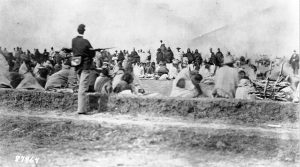
After years of discussions, Taos, N.M. decided to remove Kit Carson’s name from a widely used park in the center of town. Carson’s renown as a Western frontiersman grew from greatly exaggerated tales in pulp novels and newspaper articles. Only later did his violent exploits against Navajos and other tribes emerge. He was among the main figures in the Long Walk, the forced march of 10,000 captive Navajos. More than a third of them died.
In Michigan, the U.S. Army Corps of Engineers removed a Washington Monument-style obelisk commemorating the construction of shipping locks on Lake Michigan. The obelisk sat atop the remainder of a burial ground. Lock construction destroyed the main part of the sacred area but the Bay Mills Indian Community and Sault Ste. Marie Tribe of Chippewa Indians continue to hold ceremonies there. We’ll talk with tribal advocates about their years-long work to change how their histories are viewed by the public.
GUESTS
Jeremy Lujan (Taos Pueblo), Taos Pueblo tribal secretary
Jesse Winters (Taos Pueblo), Taos Pueblo second sheriff
Dr. Gregorio Gonzales (Comanche and Genizaro), tribal historic preservation officer for the Pueblo of Cochiti
Paula Carrick (Bay Mills Indian Community), tribal historic preservation officer for Bay Mills Indian Community
Break 1 Music: Take Your Troubles to the River (song) Vincent Craig (artist) Self-titled Release (album)
Break 2 Music: She Raised Us (song) Joanne Shenandoah (artist) LifeGivers (album)
Two new books delve into the best and worst corners of the internet. First, Jacob Geller creates YouTube essays about art, literature, film, video games and more. He’s compiled those essays in print form in a new book called How a Game Lives. In today’s episode, Geller speaks with Here & Now’s Scott Tong about how video games help him explore life’s big questions. Then, Nick Clegg was president of global affairs at Meta, a position he left earlier this year. In today’s episode, Clegg talks with NPR’s Steve Inskeep about his new book How to Save the Internet.
To listen to Book of the Day sponsor-free and support NPR's book coverage, sign up for Book of the Day+ at plus.npr.org/bookoftheday
Want to be a top notch candidate for hosting alien life? Then there's a few key requirements you should be aware of: Ideally, you're a large object like a moon or a planet; scientists suspect you also have an atmosphere and water; plus, you should orbit your star from a nice mid-range distance — in the "Goldilocks Zone" of habitability. Until recently, you would be competing against TRAPPIST-1 e. It's a planet outside of our solar system. TRAPPIST-1 e is also only 40 light years away, rocky and the same size as Earth, which prompted researchers to investigate whether it also has an atmosphere — and the potential for alien life. A team of researchers has been investigating TRAPPIST-1 e to learn more about its potential. Their answers, recently published in the Astrophysical Journal Letters, say a lot not just about this exoplanet, but about how scientists should refocus their hunt for alien life.
Interested in more space science? Email us your question at shortwave@npr.org.
Listen to every episode of Short Wave sponsor-free and support our work at NPR by signing up for Short Wave+ at plus.npr.org/shortwave.