The "snuff film" is a profoundly disturbing urban legend: the idea that a shadowy group (or groups) manufacture real-life acts of torture, defilement and murder for the express purpose of commercial gain. For decades, fact checkers and researchers argued that snuff films didn't actually exist. Yet, as Ben, Matt and Noel discover in tonight's episode... that may no longer be the case.
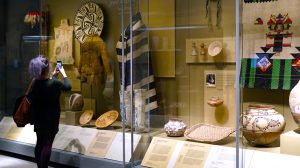
Culture keepers and historians are closely watching President Donald Trump’s review of the Smithsonian’s National Museum of the American Indian (NMAI) and other institutions to eliminate what he calls derisive or partisan narratives. It’s among eight museums that receive federal funding are that are currently under review. NMAI’s exhibits include Native American perspectives on historical documents and events that include treaties, Indian Boarding Schools, the Termination Era, the American Indian Movement, and the Indian Child Welfare Act, among many others. Those watching are concerned Trump’s directive could permanently alter how those topics are presented to the public. NMAI also develops educational curricula that counters incomplete instruction on historical events, like Thanksgiving. We’ll hear from those who were instrumental in NMAI’s founding, as well as get perspective on Defense Secretary Pete Hegseth’s announcement that soldiers that took part in the Wounded Knee Massacre would retain their Medals of Honor.
GUESTS
Dr. Suzan Shown Harjo (Cheyenne and Hodulgee Muscogee), president of the Morning Star Institute, a founding trustee of NMAI, and recipient of the Presidential Medal of Freedom
OJ Semans Sr. (Rosebud Sioux), co-executive director of Four Directions Vote
Break 1 Music: War Dance Song 1 (song) Burton Fisher, George Fisher, Charles Little Oldman, & Clifford Bighead (artist) 12 Northern Cheyenne Songs (album)
Are you creepy? How would you know? What’s “creepy” as opposed to scary or eerie? We talk to the pioneer of this research, Serpopsychologist, Dr. Frank McAndrew, a professor emeritus at Knox College. We chat: dates that give you the willies, Weary Willie the Clown, haunted dolls, college goths, dark alleyways, evolutionary neurobiology, what NOT to get Oprah, the line between horror and comedy, the phobia of balloons, dating tips, and why you should re-evaluate your bathmat. Welcome to Spooktober 2025. We have more waiting in the wings for you this month.
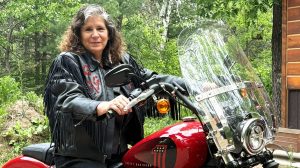
For more than three decades, Tina Kuckkahn‘s work has centered on supporting Native culture and the arts. The Lac du Flambeau Ojibwe citizen is the new head of the Native artist non-profit organization, the First Peoples Fund. She previously directed s’gʷi gʷi ʔ altxʷ: House of Welcome (The Evergreen State College Longhouse) and most recently helped build NDN Collective’s philanthropic infrastructure and grantmaking programs. She is in the process of organizing a canoe journey through the Great Lakes, retracing her ancestors’ historic migration. Tina Kuckkahn joins us as this month’s Native in the Spotlight to talk about the state of Native art, Ojibwe culture, and motorcycles.
Ernie Stevens (Photo: courtesy the Indian Gaming Association)
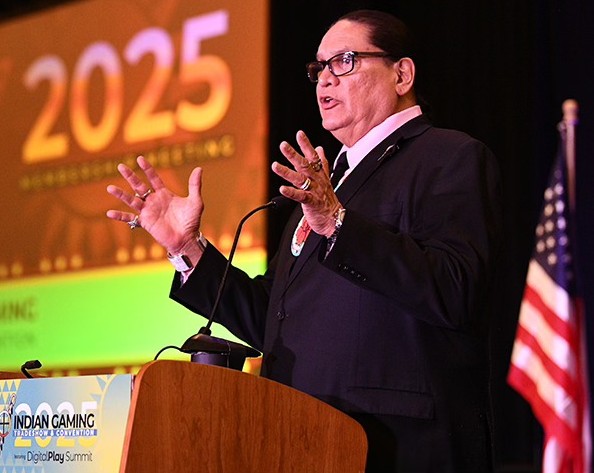
We’ll also look back at the life of Indian Gaming Association chairman Ernie Stevens Jr., who just walked on.
GUESTS
Tina Kuckkahn (Lac du Flambeau Band of Lake Superior Chippewa), president and CEO of the First Peoples Fund
Jason Giles (Muscogee), executive director of the Indian Gaming Association
Are you a survival pessimist or a survival optimist? Blair Braverman surprises Sarah with a harrowing, heartening, and sometimes hilarious tale of love and endurance in the face of certain death, but you’ll have to listen to find out the seemingly impossible circumstances our subjects had to overcome. Digressions include Sarah’s flight simulation skills, David Goggins' morning routine, and the best way to design your character in The Oregon Trail computer game.
For centuries the U.S. government conspired to persecute, attack and marginalize the native population. When open warfare became too expensive, some factions of the government proposed a different approach -- what if, they wondered, we erase native culture? This inspired a massive industry of forced assimilation. Thousands of children were forced into boarding schools where they were taught to act more 'European' while being abused, exploited and placed into forced labor. Tune in to learn more about the conspiracy of forced assimilation, and how its long-reaching consequences affect the country in the modern day.
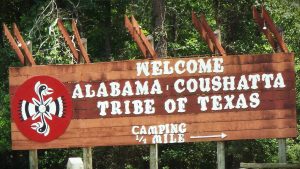
The action by Republican Texas lawmakers to redraw congressional voting boundaries to favor Republican candidates has clear implications for the Alabama Coushatta Tribe of Texas. The new contorted boundaries put the tribe at least four times the distance away from their elected representative’s base of operation. The Texas move has also spurred other states to do that same and voting advocates worry about losing hard-fought ground for Native voter representation at the polls. We’ll look at what the latest potential problem areas are and how it relates to the midterm elections.
Also, we’ll talk with a New Mexico District Attorney Bernadine Martin (Diné). She is fighting to keep her job amid allegations of incompetence and misconduct. Martin is the only female Native American district attorney in the state. She says she is being unfairly targeted.
GUESTS
Cecilia Flores (Alabama-Coushatta), tribal council chairwoman of the Alabama Coushatta Tribe of Texas
Nita Battise (Alabama-Coushatta), tribal council member of the Alabama Coushatta Tribe of Texas
Lenny Powell (Hopland Band of Pomo Indians), Native American Rights Fund staff attorney
Daniel McCool, professor emeritus of political science at the University of Utah
As world leaders convene for the United Nations General Assembly, the US Secret Service uncovers a massive telecom conspiracy -- and has no idea who created it. People are out here peeing in theatres, it's Fat Beer Week as we record, and the Pentagon declares journalists must tow the party line. All this and more in this week's strange news segment.