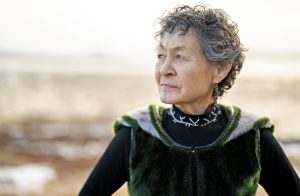
Born in Greenland, Aaju Peter did not begin to explore the breadth of her own Inuit culture until she moved to Nunavut, Canada. It was there that she got in touch with an internal drive to learn about and strengthen language, education, policy, and the arts toward improving Inuit representation on an international scale. That has resulted in a varied career as an activist, lawyer, clothing designer, and musician. Among her many accolades is the Order of Canada, awarded for her preservation and promotion of Inuit culture. Aaju Peter joins us as our Native in the Spotlight.
Break 1 Music: The Great Angakkuq [feat. Kevin Qamaniq-Mason] (song) Silla (artist) Sila Is Boss (album)
It’s Indicators of the Week (now on YouTube!). It’s our weekly look at some of the most fascinating economic numbers from the news.
On today’s episode: The US ain’t doing too hot in attracting European tech workers; OpenAI takes its video generator Sora behind the barn; and a rapper, pound cake, and the police.
Singer-songwriter David Archuleta and writer Lindy West are both out with memoirs that deal with letting go of the past. First, Archuleta was the runner-up on the seventh season of American Idol. Underneath that success, he struggled privately with his queer identity and his relationship to the Mormon church. In today’s episode, he talks with Here & Now’s Indira Lakshmanan about his new memoir Devout. Then, Lindy West tells NPR’s Leila Fadel about Adult Braces, the cross-country road trip that reset the Shrill writer’s life, and how she opened herself to the idea of a non-monogamous marriage.
To listen to Book of the Day sponsor-free and support NPR's book coverage, sign up for Book of the Day+ at plus.npr.org/bookoftheday
To manage podcast ad preferences, review the links below:
See pcm.adswizz.com for information about our collection and use of personal data for sponsorship and to manage your podcast sponsorship preferences.
Want more business storytelling from us? Check our weekly deepdive show, The Best Idea Yet: The untold origin story of the products you're obsessed with. Listen for free to The Best Idea Yet: https://wondery.com/links/the-best-idea-yet/
About Us: The daily pop-biz news show making today’s top stories your business. Formerly known as Robinhood Snacks, The Best One Yet is hosted by Jack Crivici-Kramer & Nick Martell.
What YouTube and Meta’s loss in the “social media addiction trial” could mean for your feed.
Guest: Ryan Mac, business and technology reporter for the New York Times.
Want more What Next TBD? Subscribe to Slate Plus to access ad-free listening to the whole What Next family and all your favorite Slate podcasts. Subscribe today on Apple Podcasts by clicking “Try Free” at the top of our show page. Sign up now at slate.com/whatnextplus to get access wherever you listen.
Podcast production by Evan Campbell, and Patrick Fort.
Would you drink recycled wastewater? It could be a solution to the global water crisis. But not everyone is ready to jump onboard. They say it’s not technology that’s keeping more cities from recycling their wastewater, but psychology. Experts call this resistance “the yuck factor.” We chat with water journalist Peter Annin about some history behind water recycling – and why more cities could adopt the solution soon.
This is part of a whole series on the world’s dwindling water supply. Check out the rest of the water series: Part 1: When the wells run dry Part 2: The world’s groundwater problem Part 3: Freshwater’s growing salt problem
Email us your questions about water, the wider environment – or anything else to do with science at shortwave@npr.org. We may turn it into an episode in the future!
Listen to every episode of Short Wave sponsor-free and support our work at NPR by signing up for Short Wave+ at plus.npr.org/shortwave.
The International Olympic Committee says women's events at the 2028 Los Angeles Games will be restricted to biological females, after years of controversy over transgender participation. Also: President Trump has again pushed back his threat to start bombing Iranian energy plants, giving Tehran ten more days to open the Strait of Hormuz. An initial deadline was supposed to expire on Friday. Lawyers for the former Venezuelan president Nicolás Maduro and his wife Cilia Flores argue they should be allowed to use Venezuelan state funds to pay for their defence against drug trafficking-related charges; Paul McCartney announces his first new album in more than five years; and the Manchester City striker Erling Haaland donates a rare Viking book to the town in Norway where he grew up.
The Global News Podcast brings you the breaking news you need to hear, as it happens. Listen for the latest headlines and current affairs from around the world. Politics, economics, climate, business, technology, health – we cover it all with expert analysis and insight.
Get the news that matters, delivered twice a day on weekdays and daily at weekends, plus special bonus episodes reacting to urgent breaking stories. Follow or subscribe now and never miss a moment.
Get in touch: globalpodcast@bbc.co.uk
OA1247 - Should social media companies be held responsible for the addiction and other harms their features and algorithms have caused to users? A California jury thought so this week, and in this episode recorded within hours of this historic verdict--and the day after another similar win in New Mexico--we examine the legal basis for this suit and what this might mean for thousands of similar legal actions now pending against Meta, TikTok, YouTube, and others around the U.S. Matt also explains why Trump is sending ICE agents to US airports, and how a little-noticed new addition to an existing DHS program has turned some state and local cops into immigrant bounty hunters.
Finally, we go a little deeper than usual in today’s footnote to honor the sacrifice of a federal judge in the Southern District of New York who read more than 6,000 pages of “romantasy” fiction to determine as a matter of law that a book about a part-witch/part-shapeshifter/part-demon who moves from San Diego to Alaska after the death of a parent to meet a hot guy with mysterious powers while discovering her own in urban Anchorage is not “substantially similar to a discerning ordinary reader” to a book about a half-witch/half-gargoyle who moves from San Diego to Alaska after the death of a parent to meet a hot guy with mysterious powers while discovering her own in a remote Gothic castle.